




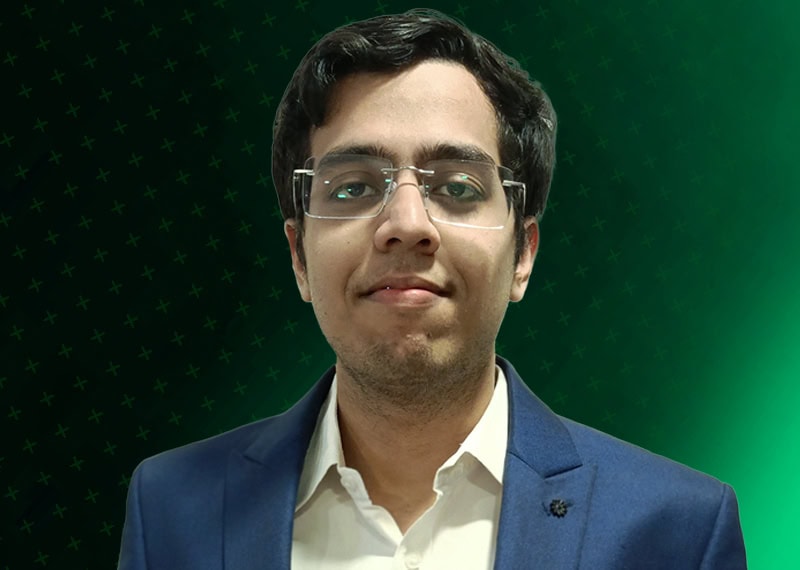
Kushager Krishnater is quickly emerging as one of the most exciting young chess coaches and chess writers. Hailing from India, this International Master started making waves not only for his playing prowess but also for his precocious coaching talent, earning him the title of FIDE Coach at the age of just 20, one of the youngest in the world to do so.
Krishnater’s journey in the world of coaching began in earnest after working with elite players like super GMs Arjun Erigaisi and Vidit Gujrathi, and later working with GM Humpy Koneru. Their partnership culminated in Humpy’s victory at the 2024 World Rapid Championships and runner-up finish at the 2025 World Cup, achievements that underscored the effectiveness of Krishnater’s coaching methods.
As a writer on Chessable, he has translated the same precision into a repertoire of acclaimed openings, including collaborations with GM Surya Sekhar Ganguly.
Whether he’s preparing ambitious juniors for competitive success, crafting playable repertoire for serious developers, or guiding GMs in cutting-edge theory, Kushager consistently aims to help students overcome psychological barriers and cultivate their natural playing styles.
In this Coach’s Corner, he talks about his experience as a chess coach and shares tips:
What is your chess training philosophy?
I firmly believe that effective coaching requires adaptability, not coercion. A coach’s role is to adapt their approach to each student’s unique needs, rather than imposing personal beliefs or rigid methods. This means customizing training based on factors such as the student’s current skill level, time commitment, strengths, weaknesses, and goals.
In essence, my coaching philosophy is to be fluid and responsive, adapting like water to meet each player’s individual needs.
Suppose a player only has 3 hours a week to practice chess. How should they spend their time?
The best approach to coaching depends greatly on individual factors such as a player’s skill level, available practice time, strengths, weaknesses, and goals. If I had to give a general starting point, I would suggest focusing on their weakest areas, dedicating time to improving tactics and calculations, prioritizing opening principles over memorizing specific moves, and encouraging them to play with full commitment and heart.
What are the biggest improvement factors for players under 1200 (Chess.com)? Under 2000?
For players ranked below 1200, I believe developing a strong understanding of tactics and calculations, alongside a strong understanding of the basic principles of openings—not specific moves—is a top priority.
For players with a rating below 2000, tactics and calculations remain important, although slightly less dominant than for players with a rating of 1200. These players should gradually increase their focus on other areas, such as opening and endgame theory, while still prioritizing calculations and tactics.

What is your preferred way to improve your skills at opening? What chess opening approaches are you trying to teach your students?
I’m a big believer in prioritizing understanding over memorizing. Knowing the “why” behind a movement is much more valuable than memorizing the movement itself. In practical play, the probability of remembering the correct opening preparation is often low. However, developing a sense of openness allows you to find effective solutions directly on the board.
My approach to teaching openings to beginners is simple: choose lines that are easy to understand and focus on the logic behind each movement, not the movement itself.
What is your preferred way to improve at the end of the game?
End game training is very subjective and depends a lot on the player’s current level. For context, let’s consider the average club player who is rated between 1200 and 2000 online.
I recommend focusing on a limited set of theoretical endgame positions—Silman’s Endgame Course is a great resource for this—while placing greater emphasis on practical endgame play, which I think is an often underrated skill. Understanding how to move your pieces, especially the king, and prioritizing active piece play in the end game is something that many players overlook. I strongly recommend developing practical skills in the end game over purely theoretical knowledge, as these skills are more likely to lead to success in the real game.
Is there anything else you would like to say to ambitious chess developers?
The landscape of chess progress has changed. You are not bound by a fixed set of rules. Do what you have to do, put your heart into it and be intense during your training sessions!
Chess course by IM Kushager Krishnater
Kushager’s courses demonstrate his strengths as a theorist and teacher: an opening repertoire built on practical plans and clear ideas that help players expand their horizons with confidence.
Check out the author page!
News
Berita Teknologi
Berita Olahraga
Sports news
sports
Motivation
football prediction
technology
Berita Technologi
Berita Terkini
Tempat Wisata
News Flash
Football
Gaming
Game News
Gamers
Jasa Artikel
Jasa Backlink
Agen234
Agen234
Agen234
Resep
Cek Ongkir Cargo
Download Film