




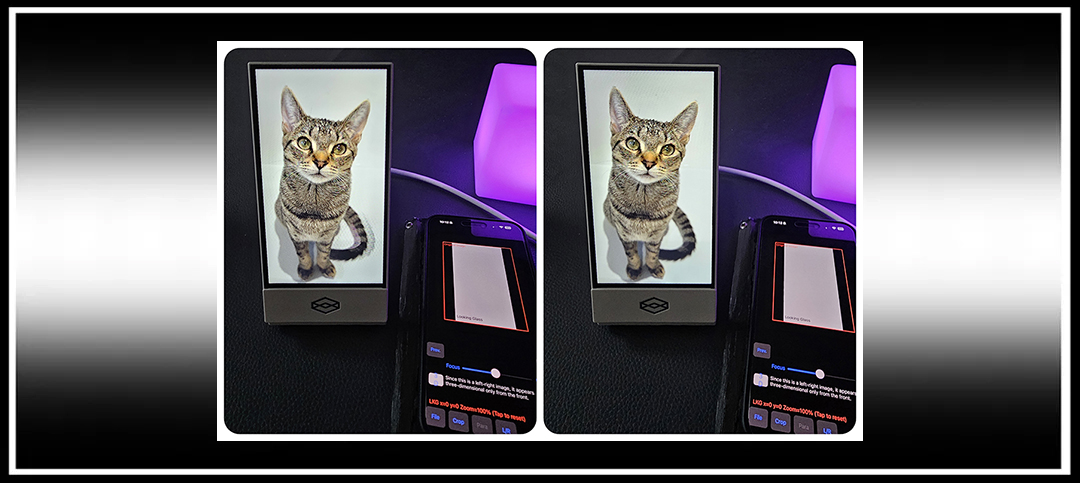
I will start by sending a great gratitude to Masuji Suto for updating the i3dmoviemaker application. He now makes it possible to display stereoscopic (3-D) and spatial photos and videos with iPhone 15s and iPhone 16 that are compatible through visible glass. This is the update we expect!
This will only function at this time with the iPhone 15s and 16s with a USB-C connection. Iphone spatial photo/video can only be taken with iPhone 15 Pro or iPhone 16s, if you choose to use it, but you can also take stereoscopic photos with other iPhone models, or import them. The appearance of ‘hologram’ through the glass that is seen also depends on binocular vision, because it will display the left and right images to each eye at the same time to get the 3-D effects free of glasses.
Using the iPhone 15/16 with i3dmoviemaker and The Looking Glass Go to display stereoscopic (3-D) and photos and spatial films
I use the iPhone 15 Pro Max and MacBook Pro to use this application, and I have previously discussed the settings in another post, but this is a step -by -step guide from the beginning, please pass to the next section without settings:
Install i3dmoviemaker and set applications with a Glass Go device that is visible
- First, install the Glass Go application that is seen on your mobile and use it to ensure the firmware of the device is updated to the latest version through the application. Also make sure your iPhone has a lot of charging in the battery, because it connects it to LGG.
- To ensure that your i3dmoviemaker application will calibrate with the visible Glass Go display, using a Mac device, and I use the application that I have installed to connect to an Android device called ‘Android File Transfer’. Connect the Glass Go (LGG) Looking directly to Mac using a USB-C, and the ‘Android File Transfer’ application must automatically open and display files on LGG. Find ‘visual.json’ and airdrop crossing to the iPhone that you will use (I have to copy it to my desktop and then airdrop). You can also use glass that looks’ ‘glass bridge’ to open files on your device via your Mac.
- On the iPhone (this can also function with the iPad with a USB-C connector) Install the i3dmoviemaker application, or if it has been installed, make sure it has the latest updates (at least version 2.50)

- To go, make sure your Glass Go device is connected directly to your iPhone using a USB-C cable, and is turned on by pressing and holding the power button (the blue light will start from blinking to be stable, and the iPhone screen will be displayed via LGG).
- Open the i3dmoviemaker application, and click on the ‘file’ lower left, then ‘settings’ below.


- Towards the bottom, click the slider to turn on ‘use the glass that is seen’ and click ‘json’, open the file that you just downloaded to your ‘rest’ and the settings for the LGG display will be arranged in the application and ready to use (please note the photo below is the old, you will need i3dmoviemaker ver.2.50, or). Now out of this menu to step into your next step.


Using i3dmoviemaker 2.50 to display photos and video stereoscopic (3-D) as 3-D binocular holograms free of glasses in the visible go go go
I made the term ‘binocular hologram’ not only because I am a Geek, but also to emphasize that when you only use two images to be displayed as 3-D through an LGG device, there will be a very narrow display window to see each image displayed on each eye at the same time, so it also relies on people who have binocular vision that serves to see it. This is not a case where you can move your head around LGG as you do for ‘full’ holograms, with at least 21 or more different appearances.
After all the settings use the steps above, make sure your iPhone is connected to the LGG device directly using a USB-C cable, and LGG is turned on by pressing the power button until the blue light repeated from blinking to stable.
- Open the i3dmoviemaker application.
- Click on ‘File’, then ‘Open the Media File’.
- Click your album containing your photo or stereoscopic video (3-D) (video will not be played in sound).
- Click on the photo/video you want to open.
- I started with stereoscopic photos, which I have taken sequentially, and use the i3dsteroid application to harmonize, but you can use imported stereoscopic photos, such as old stereoview scanning. These steps also function for side by side videos as well, as converted by the spatialify application, or imported to the iPhone.


- When you click ‘finished’ to open the selected photo/video, the application will ask what file format is that. I use a full frame, so I choose ‘full SBS’ but there are other options for different formats, including squeezed (see in the image below).

- If you find your image/video has been opened in a cross-view format, instead of the parallel view format, click the L/R or R/L button at the bottom to exchange the left and right (I often find that even though my image is stored as a parallel view, the application opens them as cross-view for several reasons).


- You can cut images here and move them by pressing ‘plants’. Remember the LGG display ratio is 9:16 (or 1440 x 2560 px), try to aim at that ratio. You will find if you choose a predetermined ratio in the application, it shows the plant grid in the landscape format, but the screen in the portrait format. You can move the blue line from the crop box to change the ratio and become a guest into a portrait format 9:16 (you will see me not right with mine, so it ends with a white line at the top and bottom-but still successful).
- When you are happy with pruning, press ‘OK’, and to make it displayed as a binocular hologram on the device, press the gray and blue ‘3-D’ buttons.
- Here you can move the ‘focus’ slider in real time to harmonize stereoscopic images to place the binocular hologram ‘behind the stereo window’ to be seen comfortably. You can also move and enlarge photos by pinching and shifting them into the application.
- The best place to see binocular holograms is directly in front of LGG, but move your head slightly to the left or right until you see two separate pictures ‘Snap’ into one 3-D picture.

- This application also allows you to scroll all your stereo photos/videos on the album and display them on LGG by clicking ‘before.’ and ‘Next’, on the slider focus blade.
- You can click on the ‘File’ menu here to save the photos you just created as a glass/video image that is seen on your cellphone, then, with the glass that looks connected directly to your iPhone, open directly on your iPhone photo album (without using the i3dmoviemaker application).
Use i3dmoviemaker 2.50 to display spatial photos and videos as 3-D binocular holograms free of glasses on the glass that is visible
If you want to know how to take spatial photos and video with Pro iPhone 15, and 16s that are compatible, please see this post.
After you are all arranged using the steps above, make sure your iPhone is connected to the LGG device directly using a USB-C cable, and LGG is turned on by pressing the power button until the blue light starts from blinking to stable.
- Open the i3dmoviemaker application.
- Click on ‘File’, then ‘Open the Media File’.
- Click the album ‘Spatial’ that contains photos and videos (video will not be played in sound).
- Click the photo/video you want to open, and press ‘finished’.

- If you find your image/video has been opened in a cross-view format, instead of the parallel view format, click the L/R or R/L button at the bottom to exchange the left and right (I often find that even though my image is stored as a parallel view, the application opens them as cross-view for several reasons).

- You can cut images here and move them by pressing ‘plants’. Remember the LGG display ratio is 9:16 (or 1440 x 2560 px), try to aim at that ratio. You will find if you choose a predetermined ratio in the application, it shows the plant grid in the landscape format, but the LGG display is in the portrait format. You can move the blue line of the plant box to change the ratio and become a guest to format 9:16.

- When you are happy with pruning, press ‘OK’.

- To get an image/video to be displayed as a binocular hologram on the device, press the gray and blue ‘3-D’ buttons.

- Here you can move the ‘focus’ slider in real time to harmonize stereoscopic images to place the binocular hologram ‘behind the stereo window’ to be seen comfortably. You can also move and enlarge photos by pinching and shifting them into the application.
- The best place to see binocular holograms is directly in front of LGG, but move your head slightly to the left or right until you see two separate ‘snap’ images into one.

- This application also allows you to scroll all your stereo photos/videos on the spatial album and display them on LGG by clicking ‘before.’ and ‘Next’, on the slider focus blade.
- You can click on the ‘File’ menu here to save the photos you just created as a glass/video image that is seen on your cellphone, then, with the glass that looks connected directly to your iPhone, open directly on your iPhone photo album (without using the i3dmoviemaker application).
And only to show it working with a spatial video too (but I failed to catch it in 2-D video, such as stereo photos in this post):
I hope this guide helps you start using the Glass Go device that is seen to display photos and video stereoscopic and spatial. Don’t forget, you can also use this application to change portrait mode photos from the iPhone, using the depth map, into an LGG hologram. For details, please see this post.
If you have an Android phone, don’t be afraid! Masuji Suto is currently working on an application to make LGG compatible with an Android stereoscopic camera phone, Xreal Beam Pro, so I hope that I will eventually work with stereoscopic photos (3-D) on Android phones and LGG. Meanwhile, you can use LGG and its application with an Android phone to turn mono-photo into a hologram, please see this post.
As usual, I hope you have a lot of fun and binocular holographic cats.
Rebecca

Copyright © The Stereoscopy Blog. All rights are protected by law.
Game Center
Game News
Review Film
Berita Olahraga
Lowongan Kerja
Berita Terkini
Berita Terbaru
Berita Teknologi
Seputar Teknologi
Berita Politik
Resep Masakan
Pendidikan
Berita Terkini
Berita Terkini
Berita Terkini
review anime
Gaming Center
Originally posted 2025-05-28 07:13:55.