



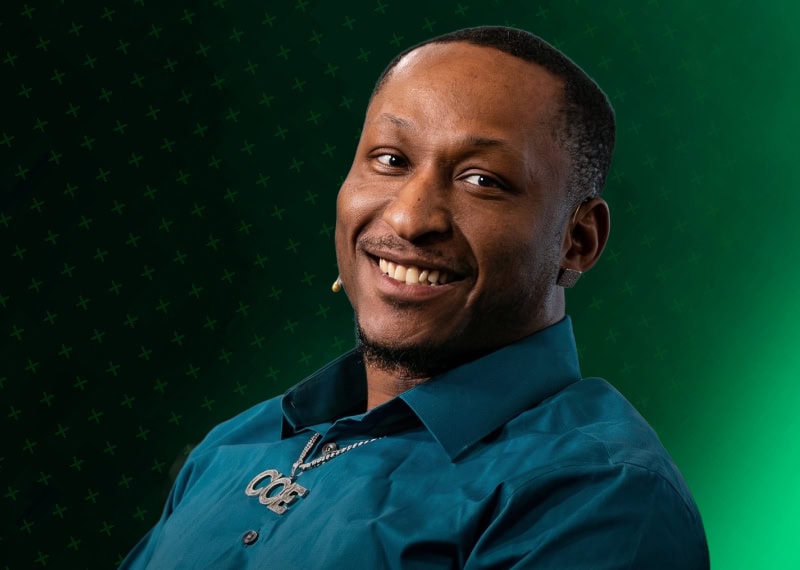
James Canty III shone brightly on many stages: as an aggressive chess player, star commentator, and most of all, World Chess Boxing Champion. But the American master also actively seeks to spread his wisdom and develop future champions. Through his Chessable courses and his role as a chess coach, Canty has helped many players reach new levels.
Long before the accolades and spotlight increased, Canty was teaching the game with extraordinary maturity. At just 14 years old, armed with a 2100 rating and an instinct for communication, he began training anyone who wanted to learn. Over the years, his coaching philosophy evolved and he became obsessed with a simple but powerful question: why do students forget so much of what they learn?
Rather than accept it, Canty devised a solution. Each lesson becomes an active process with real-time notes, structured homework, and a system designed to extend learning beyond the session itself. That impact is something Canty is very proud of. From ambitious amateurs who made huge leaps in a few months, to disciplined players who crossed the 2000 mark, to young talents who thrived under his guidance… every success reflects his methods. His reach even extended to elite athletes like the NFL’s Justin Reid, whose success was owed to Canty’s behind-the-scenes coaching.
After speaking with Canty, it’s clear that he’s not after a quick win. He strives to instill the same mindset that has shaped his journey: steady effort, daily focus, and respect for the process.
In this interview, Canty talks at length about his thoughts on chess training and shares practical tips for chess players.
What is your chess training philosophy?
My coaching philosophy is built on clarity, confidence and purposeful aggression. Even if you are a positional player, we will first strengthen it, through drills and positional drills, then return to aggressive chess. I have a training system and a thinking system that I teach to all my students. It is rooted in rigorous chess training and a 3-step way of thinking. Move 1 fails quickly and then you rely on moves 2 and 3 for the rest of the game, with aggressive chess thinking at the forefront. I teach ultra-aggressive chess, but it is based on good principles—development, initiative, activity, and pressure. The goal is to help players understand when and why to attack, not just attack for the sake of it.
My approach comes directly from my own gaming and competitive experience. I focus on repetitive attacking ideas, familiar structures, and tactical patterns that appear over and over again in real games. Rather than memorizing long machine runs, students learn how to recognize moments to seize the initiative, create threats, and force their opponents into uncomfortable positions.

Suppose a player only has 3 hours a week to practice chess. How should they spend their time?
Good question! I would recommend this: 3 days a week, 1 hour sessions.
The best work you can do is CALCULATION training, doing as many reps as possible. You count in your own game, so this is the skill you need to spend the most time on. The breakdown is like this – 1 hour – Tactical practice, puzzle rush for example, which is 5 minutes, looking for a score of 30 or more each time, 1 hour of this maximum.
Next day – 1 hour looking at MODEL GAMES, like something from the Chessable course (the game model part that many people can’t even understand!) or a game model from an ongoing tournament, like Tata Steel Chess. Sit down and try to guess the moves in the game, calculating and working out the moves; this is a really great way to practice, and get real time game play.
In the final hours of the week, I recommend playing games, quick games for about 10 minutes, so you have time to think, and make sure to analyze your game lightly as soon as you’re done.
What are the biggest improvement factors for players under 1200 (Chess.com)? Under 2000?
I think the biggest factor for improvement for players under 1200 is tactical training. Check your last 20-30 matches, they most likely ended with tactical attacks from both sides, so the better your tactics, the higher your ranking in this range.
Under 2000, it was still mostly tactical training, and ENDGAMES was right next to it. You should know some of the important end games and know which ones are easy wins for you. Hard and continuous tactical training with endgames will be the key!

What is your preferred way to improve your skills at opening? What chess opening approaches are you trying to teach your students?
Not going to lie about this one, Chessable right! USE IT. I can’t stress that enough. The chess opening approach that I teach my students is to memorize PLANS AND IDEAS first. Memorizing the moves is cool, but you’ll forget a lot of them, and if you don’t remember the idea, you can just cook it up after playing the moves straight from the book! But if you remember the idea and plan, then you can potentially discover or even remember the moves!
What is your preferred way to improve at the end of the game?
Not going to lie, I’ve had the best success just devouring endgame books. Even though I’m a HYPER aggressive player, I learned a lot of the end game, and that helps in all areas.
Here are the books I’ve read, and with Chessable, you can read them in no time!
- 100 Endgames You Need to Know
- Jeremy Silman’s Complete Endgame Course
- Van Perlo’s End Game Tactics
- Theoretical Fortress Endgame by GM Sam Shankland
- And the final boss: Dvoretsky’s Endgame Manual

Is there anything else you would like to say to ambitious chess developers?
CONTINUE. Don’t stop practicing. There is something called the compound effect, meaning, all the training you are currently doing will be combined, then one day, you will achieve a big win and a ranking increase. IT WILL PAY OFF, and NEVER let anyone deter you from your goals, or tell you that you can’t do something, this is your journey, so keep going, and keep your head up, and keep using Chessable!
Chess course by FM James Canty III
Canty’s hyper aggressive style of play was evident on his opening court:
Both courses are on sale until April 16, 2026.
For a complete list of James Canty’s courses, visit his Chessable author profile.
PakarPBN
A Private Blog Network (PBN) is a collection of websites that are controlled by a single individual or organization and used primarily to build backlinks to a “money site” in order to influence its ranking in search engines such as Google. The core idea behind a PBN is based on the importance of backlinks in Google’s ranking algorithm. Since Google views backlinks as signals of authority and trust, some website owners attempt to artificially create these signals through a controlled network of sites.
In a typical PBN setup, the owner acquires expired or aged domains that already have existing authority, backlinks, and history. These domains are rebuilt with new content and hosted separately, often using different IP addresses, hosting providers, themes, and ownership details to make them appear unrelated. Within the content published on these sites, links are strategically placed that point to the main website the owner wants to rank higher. By doing this, the owner attempts to pass link equity (also known as “link juice”) from the PBN sites to the target website.
The purpose of a PBN is to give the impression that the target website is naturally earning links from multiple independent sources. If done effectively, this can temporarily improve keyword rankings, increase organic visibility, and drive more traffic from search results.