




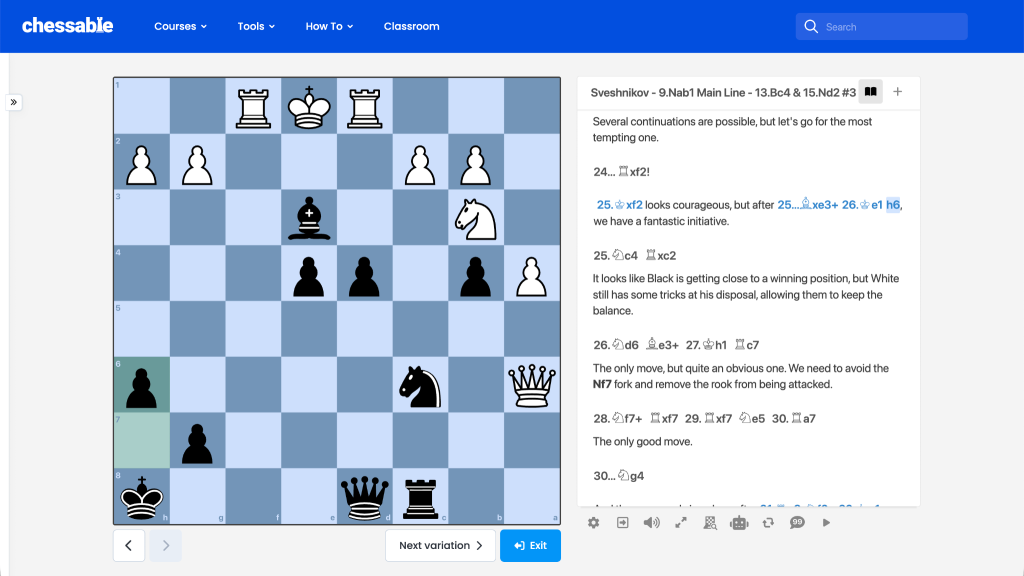
Until now, when you studied a Chessable course, you could only practice the main variations that the author chose. Additional clickable lines mentioned in written comments, the “What if they play this?” moving, it’s there to read, but you can’t drill into it.
We just changed it.
You can now take any subvariation from the course you have and turn it into a trainable variation in your own repertoire. If a writer mentions an interesting side job, alternative approach, or complex sequence of moves you’d like to do, now you can do just that.
How to do it
It only takes a few clicks:
- Open any course you have
- Find the sub variation that you want to convert to trainable
- Right click on it
- Select “Add to Repertory (up to this step)”
- Choose which repertoire and chapters to add
- Click “Add variation”
Just that. The variation will now appear in your selected repertoire, ready to be practiced just like any other line.
Find the subvariation that you want to turn into a trainable variation

Select “Add to Repertory (up to this step)”

Choose which repertoire to add trainable variations to.
Each line is now yours to practice.
The authors pack their comments with ideas, alternatives, and caveats – sentences that are truly worth knowing. Now you can actually learn it.
PakarPBN
A Private Blog Network (PBN) is a collection of websites that are controlled by a single individual or organization and used primarily to build backlinks to a “money site” in order to influence its ranking in search engines such as Google. The core idea behind a PBN is based on the importance of backlinks in Google’s ranking algorithm. Since Google views backlinks as signals of authority and trust, some website owners attempt to artificially create these signals through a controlled network of sites.
In a typical PBN setup, the owner acquires expired or aged domains that already have existing authority, backlinks, and history. These domains are rebuilt with new content and hosted separately, often using different IP addresses, hosting providers, themes, and ownership details to make them appear unrelated. Within the content published on these sites, links are strategically placed that point to the main website the owner wants to rank higher. By doing this, the owner attempts to pass link equity (also known as “link juice”) from the PBN sites to the target website.
The purpose of a PBN is to give the impression that the target website is naturally earning links from multiple independent sources. If done effectively, this can temporarily improve keyword rankings, increase organic visibility, and drive more traffic from search results.